Recent Posts

Showing posts with label Intel. Show all posts

Saturday, May 19, 2012

AMD's Trinity Processor vs. Intel's Ivy Bridge 3D !!

AMD’s next-generation A-Series processors, code-named Trinity, are the chip manufacturer’s answer to Intel’s new Ivy Bridge processors now appearing in the new Ultrabook laptops.
How much of an improvement do the new Trinity chips offer laptop users and can these new Trinity-based laptops compete against Ivy Bridge? The reviews are in.
Every new generation of chips promises better performance and energy efficiency, and Trinity is no exception. Earlier this year, AMD claimed Trinity would offer significant improvements over its current Llano chips: An overall performance increase of up to 25 percent, 50 percent better graphics performance, and double the performance per watt.
Across the web, tech reviewers have been benchmarking an AMD Trinity test laptop (featuring the A10-4600 quad core processor with integrated Radeon HD 7760G graphics) to put these claims to the test. We’ll have our own tests from the ITnewsTouch Labs soon, but this is how the new accelerated processing unit (APU) is being received so far:
Modest General Performance Improvements: Not Enough to Best Intel
Intel is still the market leader in this highly competitive chips race and, unfortunately, going on CPU performance alone, Trinity still lags behind. Both VR-Zone and HotHardware say the Trinity A10 gets “blown out of the water” by Intel’s Ivy Bridge Core i7 CPU--and even against Intel’s second-generation Sandy Bridge mobile chips in some tests.
AMD positions its top-of-the-line A10 series against Intel’s lower-end Core i7 and higher-end Core i5 chips. Yet an Ivy Bridge mid-range i5-2410M had a 25% CPU performance advantage over the Trinity A10-4600, according to AnandTech’s comparisons using PCMark.
VR Zone is frank in its assessment, calling Trinity’s single threaded applications and raw memory performance “abysmal.”
Still, AnandTech says Trinity’s new is a step forward from the CPU cores used in Llano. Trinity was about 20 percent faster than Llano in the reviewer’s general CPU performance tests--close to AMD’s 25 percent promise.
(Intel’s Ivy Bridge CPU gains over its Sandy Bridge processor were also modest: About 5 to 10 percent faster in ITnewsTouch tests.)
Great Integrated Graphics, Gaming Performance
As with Intel’s Ivy Bridge, AMD Trinity’s biggest gains are on the graphics side. Tom’s Hardware found Trinity “soundly beating its competition” in graphics processing and--as you see in this chart--in this testing, Trinity leads even against a Llano laptop with a discrete graphics card (the older 3DMark Vantage metric was used to compare against the Intel Sandy Bridge chip, which doesn’t support DirectX 11).
Trinity even bests Intel Ivy Bridge’s impressive graphics performance: The HD7760G integrated graphics processor (IGP) had a 30-percent to 50+-percent performance gain over the Intel HD 4000 IGP in an Ivy Bridge Core i7 chip, according to HotHardware.
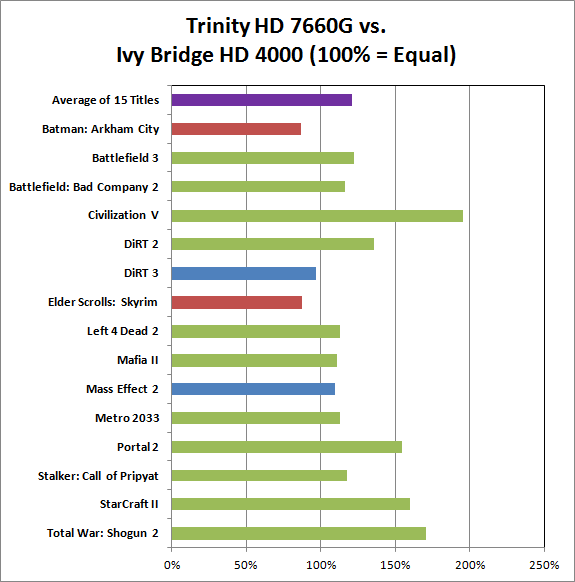
This finding would make Trinity really impressive for gaming. Hexus said the chip “offers best-in-class performance and enough grunt to play modern games at reasonable image-quality settings.” In AnandTech’s tests, Trinity had an average 20% lead against Ivy Bridge when comparing performance over 15 game titles. For 11 out of the 15 games, Trinity came out on top.
Significantly Better Battery Life
AMD also managed to significantly improve battery life on Trinity compared to previous AMD chips and even when compared to Ivy Bridge--even though Intel uses a new 22nm production technology, while Trinity still uses the 32nm process of older Llano chips (smaller chips tend to be more energy efficient).
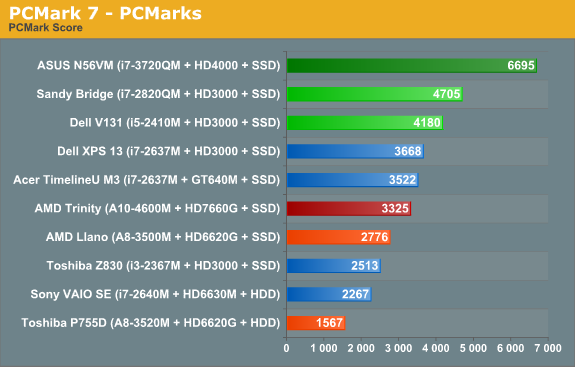
In this AnandTech chart, look at the red bar for Trinity, orange for Llano, and dark green for the Asus laptop equipped with an Ivy Bridge processor to see the battery life performance differences.
AMD claims 50% better battery performance from a Trinity laptop versus Llano--up to 8.5 hours of browsing or 4 hours of YouTube video streaming, according to Slashgear.
Conclusion
Taking the synthetic test results (on a prototype laptop) with a grain of salt, an AMD Trinity-based laptop may tempt you, depending on your needs.
If you require a mobile powerhouse with the best processing performance possible, an Intel quad-core i7 will be your better bet. But if you’re a gamer or want longer battery life in your laptop, AMD has an edge over Intel.
And despite the less-than-overwhelming overall CPU performance gains, Trinity-based laptops will be more than fine for mainstream tasks.
Also not to be dismissed: Trinity-equipped laptops will, in general, be cheaper than laptops equipped with Ivy Bridge processors. For instance, AMD’s ultrathin laptops are set to be priced about $200 lower than Intel Ultrabooks.
The HP Envy Sleekbook with AMD processor is the first example of this; the Sleekbook is $150 cheaper than HP’s new Envy Ultrabooks with Intel processors.

Thursday, May 17, 2012

Intel's Death are Widely Exaggerated!!

If you've ever struggled through a skiing lesson, you know exactly what the expression "too far over your skis" means: You're headed in the right direction, but you're leaning so far forward you're going to take a tumble. And that's what's going to happen to my colleague Galen Gruman, who along with other pundits is falling all over himself to bury Intel under the oncoming ARM tsunami.
Yes, as many of us have written, the old PC-centric computing model is running out of gas as tablets and smartphone become more powerful and more central to how we live, work, and play. That's the right direction. But timing is everything -- there's lots of evidence that Wintel (the Microsoft-Intel partnership) still has many years left in it -- which is why Gruman and others are seriously ahead of themselves.
This is a big topic, so I'm going to stick to one part of it: Intel's ability to compete with ARM in delivering high-performance, low-power chips in packages tailored for mobile devices. One name to keep in mind in this discussion is Zolo, the Android-based smartphone from Lava now selling in India.
"People who have seen it say that it is comparable in performance to [smartphones based on] Qualcomm's Snapdragon and Nvidia's Tegra," the ones used in practically every Android smartphone sold in the United States, says Nathan Brookwood, the principal analyst of Insight64 and a longtime observer of the semiconductor industry. The smartphone's energy efficiency is likewise comparable to these established ARM chips -- except Zolo uses Intel's x86-based Atom chip. That's why counting Intel out, Brookwood says, is a big mistake.
Intel versus Qualcomm and Nvidia: An uneven match
The chip inside Lava's Zolo is based on Intel's new Medfield design. Without getting overly geeky, it's important to note that the chip used in the Zolo is still being produced on the old 32-nanometer process. A year from now, Intel will shift its mobile chips to the same 22-nanometer process used in the just-shipped Ivy Bridge laptop and desktop chips.
Why is that important? The smaller process means far more transistors and far less heat. If Intel is competitive at 32 nanometers, what happens when it shifts to a more aggressive process?
It's also important to remember that Intel owns its own fabs and controls its own process technology, while its competitors generally use foundries owned by companies like TSMC that do not have the same mastery of process technology, notes Brookwood. Don't forget the addition of trigate, or 3D, transistor technology to increase both computational power and efficiency.
That's not to say Nvidia and Qualcomm won't be improving their own ARM chips. Ditto for Apple, which designs its own ARM chips for its iOS devices. Of course they will, Brookwood says. But now that Intel has decided to focus on performance per watt, as opposed to pure computational performance, it's a very different ball game.
A pair of announcements during last September's Intel Developer Forum demonstrated Intel's power in the mobile industry. Intel CEO Paul Otellini and Google's Android development boss Andy Rubin appeared on stage together, and Rubin promised, "We're going to collaborate very closely to make sure that Android is optimized the best it possibly can be for the Intel architecture."
He added, "Going forward, all future releases of Android will be optimized [for Intel]."
Moreover, Intel is one of the largest suppliers of code to the Android code base, says Dean McCarron, principal analyst of Mercury Research. If Intel didn't believe it was going to get something significant out of Android, would it make those contributions just to be a good citizen? Of course not.
So why does Gruman believe that "Intel is kept at the back of the line in terms of support and access to the pseudo-open source Android code"? I don't see any evidence of that, but maybe I'm missing something. Gruman tells me it's the utter lack of Android 4 "Ice Cream Sandwich" devices using Intel chips, though Android 4 first shipped for ARM devices six months ago. Intel says to expect Intel-based Android 4 devices soon and notes the first Android 3.3 "Gingerbread" Intel-based devices shipped last month.
The other key announcement at the Intel Developer Forum came from Motorola Mobility, which signed an extensive "multiyear, multidevice strategic partnership" with Intel to produce Android-powered smartphones and tablets. Motorola wouldn't have done that without looking very closely at Medfield, and it must have concluded that the Intel platform is indeed competitive with ARM in power consumption and raw performance.
Once these devices are in the market, we'll see something new: serious competition for the Qualcomm and Nvidia ARM chips used in most Android devices.
Will you get work done on ARM?
Another exaggerated story line is the threat ARM chips pose to Intel in the productivity market. Sure, Qualcomm showed off a PC-like device earlier this year, but what anyone will be able to use it for is hardly clear.
"I'm quite skeptical," says Mercury Research's McCarron. The software infrastructure is dominated by the classic x86 architecture of Intel and AMD. In particular, Windows 8 on ARM will not support binary translation, so any apps written to run on it will have to be rewritten from the ground up, he says.
Here, too, there is some nuance. McCarron notes that the rise of the app stores will make it easier for independent developers to write and sell ARM-specific apps that could get some traction with the public. Plans on the drawing board for new chips by Qualcomm and Nvidia, expected to debut around 2015, could change the game, he says.
A report by Flurry, a mobile analytics company, found that an astonishing 1.2 billion apps were downloaded between December 25 and December 31, 2011. About 20 percent of those were tablet-specific, estimates Flurry's Peter Farago. However, only 1.4 percent of those downloads were productivity-related, meaning that most people are not relying on their mobile devices as the primary means of getting their work done.
So with all due respect, Galen: Your pronouncement of Intel's death is greatly exaggerated. I hope you're wearing a crash helmet.

Friday, April 13, 2012

Intel's New "Ivy Bridge" 3D Chips May Launch April 23

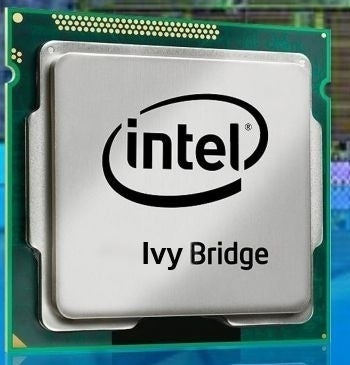
Intel's Ivy Bridge 3D Chips May Launch April 23It's almost time for systems based on Intel's Ivy Bridge chips to take their place in the spotlight. CNET says it has learned that the first of several Ivy Bridge-related announcements will transpire on April 23.
Ivy Bridge is Intel's codename for its follow-up to the Sandy Bridge processor family. Ivy Bridge shrinks the manufacturing process from 32 nanometers to the 22nm Tri-Gate process Intel detailed last year. Older processors are based on "planar" or flat 2D transistors, but there's only so much headroom in chips based on 2D processes. By switching to 3D transistors, Intel promises we'll see a 37 percent increase in transistor switching speed as well as roughly half the power consumption of 2D transistors.

Intel's Ivy Bridge 3D Chips May Launch April 23Intel was originally tipped to launch Ivy Bridge in early April, but rumors suggest the processors could be delayed because consumers weren't buying up older notebooks quickly enough -- partly because the economy remains sluggish, partly because Windows 8, an obvious sales driver, won't arrive until sometime this fall. In late March, the rumored timeframe for Ivy Bridge's debut shifted again to the last week of April.
When Ivy Bridge does arrive, shoppers can probably count on older Sandy Bridge-based computers, particularly Ultrabooks -- which still start at $800 and range to over $1,700 -- to plummet in price. Intel’s general manager, Kirk Skaugen, recently said that current Ultrabook prices could drop to $699, and that 75 Ultrabook designs are in the pipeline, including hybrids that can shift from laptops to touchscreen tablets.
CNET’s report is seconded by Asian rumor site DigiTimes, which claims Intel originally planned to announce Ivy Bridge's arrival April 29, but kicked the announcement up a week (though it doesn't say why). April 29 is a Sunday, so the original Ivy Bridge launch date doesn't add up.
Intel's Ivy Bridge 3D Chips May Launch April 23
One of the most anticipated albeit still rumored tie-ins to Ivy Bridge's launch is the debut of 15- and 13-inch MacBook Pros from Apple. The laptops are reportedly in production, and they may resemble the MacBook Air in terms of the Air's tapered, blade-like design. When might we see those? As early as May, or as late as June, according to the rumor mill.
On the Windows side of mobile, DigiTimes says to expect Ultrabooks from Asustek, Acer, Hewlett-Packard, and Lenovo in May.

For More Info: Click Hare